Showing posts with label Roy Crane. Show all posts

Thursday, October 22, 2026

Recently Read: Super Boys, by Brad Ricca


Fans of comics and comics history have long awaited a book about Jerry Siegel and Joe Shuster, the creators of Superman and Brad Ricca's Super Boys is, for better or worse, the best one we might ever get. It details their lives, delves into their families' pasts and, awkwardly, explains some of what happened after their deaths.

From the first page of the prologue, Ricca, in an attempt to tell a compelling story, dramatizes what may have happened. Ricca describes and presents feelings and actions he wasn't privy to: "He glanced at the black typewriter on his desk..."; "Joe was yawning a lot lately."; "He walked into the store, his peripheral vision on overdrive."; "Across town, a girl pins her hair back...". This made-for-TV docudrama-like technique is annoying and not appropriate for a serious work of non-fiction.

I did learn much from Ricca's research, such as that most of Siegel and Shuster's run on the fun Slam Bradley series was created for DC before Action Comics No.1. I didn't know Jerry Siegel had created The Spectre. The author goes into great detail concerning the duo's high school experiences and Siegel's published pulp magazine letters and gleans a lot of information from local newspapers during the boys' time in Cleveland. In one amazing exploration, Ricca points out the many connections between what was published in an edition of a Cleveland newspaper and plot elements from Superman around the time Siegel was conceiving of the series. Even if Siegel hadn't read that particular copy of the paper, it demonstrates how much of the series' ideas were in the air, as if the character had to exist, or as if Siegel had plucked the ideas out of the cultural ether. Much is also made (and rightly so) of the many autobiographical themes in Siegel's Superman. The book's notes are nearly a hundred pages long and contain much fascinating information.

For all the book's formidable research, though, one wishes Ricca had a deeper knowledge of 20th century pop culture, for the book is marred by many easily verifiable mistakes. It was Douglas Fairbanks, Sr. who the duo saw on screen as Zorro, not Douglas Fairbanks, Jr. The Dragon Lady was created by cartoonist Milton Caniff, not Roy Crane. Contrary to what Ricca states, Joe Simon created no work for Marvel Comics in the '60s, and stating in the same paragraph that Stan Lee was a genius, while only an opinion, is an extraordinarily misguided one. These kinds of statements make me reconsider - or distrust - other items presented as facts in the book.

The last section of the book is the most problematic, dealing with Siegel and Shuster's survivors' lawsuits with Superman's corporate parents and a myriad of sometimes dubious lawyers. The scenarios feel blurry and rushed, with not enough context for the reader to be able to understand or appreciate what transpires. Dialogue from many depositions are quoted, almost as if Ricca had worked hard to research them, so thought they needed to be included. One paragraph continually jumps back and forth between past and present tense, even in the same confusing sentence.

At the end, this reader is left with many questions unanswered by the text. Why didn't the duo consider a way of getting legal advice before they signed the rights to Superman away? Considering the duo's success with Slam Bradley, Superman and other series, why didn't they create other new series to sell after DC fired them beyond the abysmal Funnyman? There were many comic book companies out there. Since the '70s Superman movie was such a big event, what did the two think of it? Why did Jerry Siegel make no effort to contact or build a relationship with his son? In his long life, what did Joe Shuster do for decades (other than the couple of projects the book describes)?


Siegel and Shuster were in the unique and ironic position of being disregarded when they were alive, but now highly regarded now that they're gone. Their most famous creation, in the meantime, becomes more famous (and financially valuable) as each year goes by. The injustices the men suffered as detailed here are of a cautionary nature for creatives everywhere.

Pin It

Monday, April 10, 2023

Comics I've Recently Read, April 10, 2023


Pin It

Tuesday, January 2, 2018

Recently Read: Golden Age Marvel Comics, Vol. 1


This volume is tabula rosa for Marvel comics, reprintings of the earliest comics Marvel published, starting in 1939: Marvel Mystery Comics 1-4. The (Golden Age android) Human Torch gets his start here; some of the other serialized strips are the Tarzan ripoff Ka-Zar (pulled over from the company's pulp magazines), Ferret, a bland detective with a ferret on his shoulder, The Angel, a bland superhero with no powers, the robot Electro, boldly drawn by Steve Dahlman. The star of the show is Bill Everett's lovingly written, drawn and colored Sub-Mariner, here, as always, an enraged terrorist wanting to sometimes destroy western civilization and helping it at others. A Roy Crane-influenced war strip, American Ace, died too soon, but every issue of Marvel Mystery Comics is worth your time, a precious snapshot of comics history.

Beware: avoid the original 2004 printing, which I unwittingly paid good money for. It's the worst comic book reprint reproduction I've ever seen; it looks like a bad microfiche source, wretchedly "fixed", with illegible lettering, dropped out and darkened art in every panel and incorrect coloring. That reconstruction was by Jerron Quality Color in Sparta, Illinois. The cover price was $50! The 2011 edition, by Pacific Rim Graphics (art) and Wesley Wong (colors) is markedly improved.

Pin It

Thursday, September 4, 2014

Hey Kids!! Comics For Sale!!

I accept PayPal payments on all the comics below, payable to: mneno@columbus.rr.com.

Classic Adventure Strips #4, published by Dragon Lady Press in 1985. Features Buz Sawyer by Roy Crane and Johnny Hazard by Frank Robbins. Magazine-sized, 64 pages, Very Good cond. $7 ppd.

 The Sixth Gun: Sons of the Gun #4. Near mint, $6.00 ppd.


 Demon Knights #1-3, near mint, $10 ppd. for all three.

Reggie's Jokes #32. 1975. Fine. $6 ppd.
Pin It

Saturday, March 29, 2014

Recently Read: Scorchy Smith and the Art of Noel Sickles


Quite simply, Noel Sickles' 1930s run on the comic strip Scorchy Smith is the ur-text of American adventure cartooning. Though Roy Crane's Wash Tubbs and Captain Easy led the way, Sickle's single-handed and seemingly off-handed advancement of using ink and brush-based chiaroscuro to define shadows, forms, figures, compositions and objects revolutionized and galvanized entire generations of cartoonists.

The first cartoonist who utilized Sickles' new technique was his friend and colleague Milton Caniff, who applied it to his Terry and the Pirates strip, with amazing and classic results (Caniff's writing and strip characters were better, so the graphic advancement in his strip brought the quality of comic strips to a whole new level). Nearly every major adventure cartoonist afterwards applied Sickles' new techniques to one extent or another, far too many than can be listed here: Jack Kirby, Carmine Infantino, Don Heck, Alex Toth, Lee Elias, Wally Wood, Will Eisner, Frazetta, Johnny Craig, Frank Robbins, George Tuska, Alex Raymond...

Scorchy Smith and the Art of Noel Sickles reprints every Scorchy Smith strip Sickles drew, including strips before he started and after he left. That's only the second half of this very heavy and large, nearly 400-page book. The first half functions as an excellently researched biography by Bruce Canwell accompanied by hundreds of beautifully reproduced color and B&W illustrations, ads, paintings, sketches, comics and graphics
of all kind by Sickles through his long career. Jim Steranko wrote the introduction.

I cannot recommend this fine book enough; it's an essential, foundational reference and document for any serious reader of comics and scholar of the art of cartooning. The only small compaint I have is the binding developed for the book isn't adequitely strong enough for the weight of the pages the book holds.Though I was very careful, the end papers began to tear away from the book. A book which weighs 6 and a half pounds needs much stronger binding, especially at $50.
Pin It

Sunday, March 16, 2014

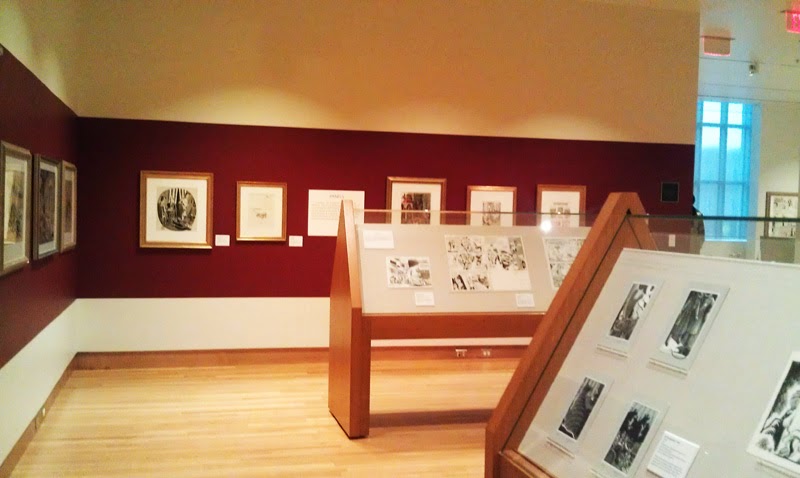
Pics from the Billy Ireland Cartoon Library and Museum Exhibit, "Substance and Shadow: the Art of the Cartoon"

                                                    Jeff Smith art from Bone.

                                    Milton Caniff art from Terry and the Pirates.


                                         Chester Gould art from early Dick Tracy.


Winsor McCay explosion.


Hal Foster art from Prince Valiant. Notice Foster's influence on Barry Windsor Smith in the second panel.


Sergio Aragones art.


Jack Kirby and Frank Giacoia art from Captain America.


Neal Adams art from the famous "Answer me that, Mr. Green Lantern!" story.


Winsor McCay editorial art.


New Yorker art by Roz Chast. 

 Hulk art by Marie Severin.


Mutt and Jeff art by Bud Fisher.


Blondie, by Chic Young.


Mort Walker's Beetle Bailey.


Guess who?

More McCay.


George Herriman's Krazy Kat.


Cliff Sterrett art from Polly and Her Pals.


Robert Crumb.


John Buscema Conan art (inked by Rudy Nebres?)

Chris Ware.


Fred Lasswell (or Bllly DeBeck?) art for Barney Google and Snuffy Smith.


Gorgeous Roy Crane art for Wash Tubbs and Captain Easy.

E.C. Segar?

Basil Wolverton's take on FDR. 

Close up of Carl Barks pencils.

Animation cel art.

Felix the Cat, by Otto Messmer.


Floyd Gottfredson's Mickey Mouse.

Billy, from The Family Circus, by Bill Keane 

McCay again, drawn for his animated film, Gertie the Dinosaur.

Cartoonist Max Ink, enjoying the exhibit. 


Pin It