Showing posts with label Argosy Magazine. Show all posts

Friday, August 7, 2020

Recently Read: The Crackpot, by John E. Stockman


Written in the '60s and '70s for obscure, self-published fanzines, these satirical tall tales by John E. Stockman were chosen and edited by author Dwight R. Decker, with some historical background provided for each story.

Those, like me, who live in the intersection of a Venn diagram consisting of old comic books, pulp magazines, fanzines and Edgar Rice Burroughs, will find these tales especially entertaining. Put simply, this is one of the funniest, craziest books I've read, consisting of (with the exception of one short and sweetly told aside) tales of obsessed, self-absorbed, untrustworthy, easily provoked fans downright desperate to print their next fanzine, grasp ERB first editions and own old copies of Tip Top Comics.

One particular story, about the near-ownership of a back-issue comic book shop almost enters the realm of pathos. Stockman, who probably wouldn't have guessed his stories would still be read in the year 2020, has created a world of fascinating greed and infantile avarice. If the figure of a desperate, chased thief trying to make his way home in the dead of night through back yards and alleys, while grasping onto a stack of old Argosy magazines, sounds intriguing, you must purchase this book. There are more Stockman short stories which haven't been collected; if they are, I'll buy them.
Pin It

Friday, July 12, 2019

Recently Read: Argosy Magazine, March 2nd, 1918


This issue is the fourth 1918 Argosy I've read consecutively (starting with Feb. 9th), and it's an all-around entertaining issue. The serialized novel begun in the issue is "To Make or Break", a sea-faring tale by Captain Aylward Edward "A.E." Dingle. A life- long adventurer and pulp writer, Dingle knew the sea well. His tale involves a crusty old ex-con assigned to test the bravery of the son of his previous love. Will the lad turn out good, like his mum, or evil like his dad? Guess.

Published as a whole is Frank A. Russell's "Game and Rubber", a match of wits between
a Mexican guerilla and celebrity/occassional detective Ronnie Campbell. "Game and Rubber" refers to an earlier Campbell story. I don't know where that one was published, but a future Campbell story appears in the June 22nd, 1918 Argosy.

Actor, performer, conservationist and all-around teacher and entertainer Chief Henry Red Eagle contributes a revenge story set on a Missiquoi reservation. A good tale, but could have been fleshed out more (it "tells" when it needed to "show"). It's the second story in the issue in which a doctor is accused of deliberately botching an operation.

George M. A. Cain's "His Maid of the Northland" continues, a story of love and murder in 
an Alaskan mining town. It's suspenseful - I want to know what happens next - and is 
noteworthy in that it expresses and shares the viewpoints of all three main characters 
in its love triangle. 

Part III of Lenivers Carew's "A Kashmir Abduction" is equal parts comedy and suspense.
Rex Parson's rugged terrain love story "All Man" ends in this issue.

The rest of the short stories are fairly predictable crowd pleasers. I'd like to learn more about Madeleine Sharps Buchanan, who apparently wrote a series of '20s detective novels. Her "As the Snow Fell" is funny and droll, ruined by the last two unbelievable paragraphs. The story was geared up for a twist ending which should have happened, but didn't.

Also noteworthy: an editorial request from Franklin Roosevelt, then Assistant Secretary 
of the Navy, for binoculars, spy-glasses and telescopes from citizens, to be sent to the 
Navy for the rental cost of one dollar (or, purchase cost if the items could't be returned 
after the end of WWI).
Pin It

Friday, November 23, 2018

Recently Read: Argosy Magazine, October, 1898

Whereas the 1896 issue of Argosy magazine I read a few years back was a mixture of news articles and fiction, the October, 1898 issue is (apart from a few slick ad pages) a full-fledged pulp magazine - Argosy was the first pulp magazine - and completely dedicated to fiction (there's not even a letters page or editorial).

The emphasis in this issue is the Spanish–American War, just ended two months before the issue was published. The Battle of San Juan Hill (including Theodore Roosevelt and his Rough Riders) and a romanticized telling of the sinking of the USS Merrimac as a block-ship are described or referred to in two stories (they must have been quickly written and submitted): "The Ninth Hero of the Merrimac", by John P. Ritter (complete in the issue) and Col. Aaron Ainsworth Burr's serialized "Through the Blockade" (the least well-written of the issue's offerings).

Most of the rest of the stories take place in exotic lands, tales of heroism and triumph. Frederick (author of many hundreds of Nick Carter novelettes) Van Rensselaer Dey's "The Brotherhood of Silence" takes place in Czarist Russia; Charles Edwards Barns' "A Fair Slave To the Mahdi" is a tense rescue story taking place in the Sudan (and easily one of the best written pieces in the issues). An exciting mail-carrier story takes place in Siberia.

William Taylor Adams (writing as Oliver Optic) has me hooked on his serialized "The Hermit's Secret", another falsely-accused-and-fighting-to-regain-his-name thrillers of the kind Hitchcock built a career on via novelists like John Buchan. I'm eager to get the November '98 issue to find out what happens next.
Pin It

Wednesday, May 4, 2016

20 Great Authors, 20 Giant Volumes


Pin It

Thursday, January 28, 2016

Recently Read: Argosy, February 23, 1918


This issue begins a new serial (the cover story) which, like some of the short stories and the complete "Along Mystery Trail", by Frank Blighton herein, contains too many coincidences or obvious turns-of-plot to be entirely enjoyable. The continuation of the serials "A Kashmir Abduction" and Achmed Abdullah's "The Trail of the Beast", though, were welcome sights. The political intrigues in "The Trail of the Beast" are, unfortunately, still relevant. The ending of Victor Rousseau's "Fruit of the Lamp" was the best of all, continuing a humorous, whimsical situation comedy-fantasy not unlike P.G. Wodehouse's concoctions. 

I enjoyed a letter from a longtime Argosy reader, Theodore Wells. Here's an excerpt: "...Why, I even forgot to eat supper, and I never left the book till I had read it from beginning to end. I really forgot that picture-shows or the like existed when I got to reading The Argosy. From now on I can look to many comfortable hours with The Argosy, and will continue to read it and also the All-Story Weekly until I leave this world."
Pin It

Wednesday, October 2, 2013

Recently Read: Argosy Magazine, February 16, 1918


A few thoughts and notes on this issue, which begins with the first part of Lenivers Carew's "A Kashmir Abduction" - one of the better stories in the issue, with characters and banter similar to a good, pre-code film. Like many of the stories herein, WWI was an integral part of the plot. I could find no biographical info on Lenivers Carew online.

A complete novel (really, a novella), "The Sixth Domino", by Reese James was next. I found it tedious in places, partly due to too many characters (suspects) to keep track of and partly due to not caring about the characters. James creates a private detective, Rutherford Jones, whom one suspects James hoped would carry over many stories (and maybe he did), but I found the character dull. Again, I could find no biographical info on Reese James online.

Achmed Abdullah's serialized "The Trail of the Beast" is an okay political intrigue set in Paris, which makes the "bad guys" those who are trying to upset France's imperialistic ventures. Also included are the last part of a western that I found nearly unreadable, "All Man", by Rex Parson, and a section of an average action thriller, "Odds And the Man", by Varick Vanardy (Frederick Van Rensselaer Dey, famous for writing Nick Carter stories).

The best of the serialized novels was another chapter of Victor Rousseau's "Fruit of the Lamp", a very funny and fast paced whimsical fantasy that could have been the inspiration for 'I Dream of Jeannie". Rousseau is better known today for his early science fiction and Jim Anthony novels, but he's superlative at comedy here. (I recently illustrated a book collection of new Jim Anthony short stories - more about that soon.)

The accompanying short stories are of varying degrees of quality, as was always true of Argosy and similar magazines. They range from character studies to murder mysteries and jingoistic propaganda. My favorite was "A Grass Orphan", a story in which a young guy on the make discovers to his detriment that the young girl he "picked up" in the park wasn't as naive as he anticipated. It's interesting that the term "flapper" is used in the story. I thought this word wasn't coined until the '20s, but it appears to have been used, with varying meanings, for many decades previous. Likewise, I thought "hep" was a '30s or '40s-coined word, but "The Sixth Domino" features this startling sentence: "Well, early this morning he put me hep to all the headquarter's dope."

As might be expected, the protagonists are all white. Non-whites are relegated to either subservient or villainous roles. This is exasperated by fiction's tendency at the time to explain or portend people's action and character by their physical attributes - non-whites get the suspicious sounding physical descriptions. This tendency to define characters (regardless of race or ethnicity) by their physical attributes is seen in literature as worthy as Henry James' and as low as the the cheapest magazine. The patronization and derogation of "the other" even goes as far as dissing music that's not of western European origin. In "The Captain and the Miracle", Edna Wahlert McCourt describes, "From a dance-hall somewhere up the street floated insidious rag-time." and in "A Grass Orphan": "A "Jazz" band squealed and hammered..."

The letters page, as always, is insightful and entertaining, with several readers commenting that they're glad Argosy is now a weekly. One gets the impression many readers were living in isolated rural areas, giving their weekly reading of Argosy, with its exotic and varied locals, a crash course in world traveling.

I'm hoping it won't take as long to find time to read the February 23rd issue, which I don't own. Anyone have a copy for sale?
Pin It

Tuesday, July 9, 2013

Wanted: Argosy Magazine, February 23rd, 1918

If you have a copy of this issue for sale, please contact me. I'd like to purchase it and read it. Thanks!
Pin It

Tuesday, March 19, 2013

Harley-Davidson Motor Co.


Pin It

Sunday, March 17, 2013

Colgan's Mint or Violet Chips


Pin It

Friday, March 15, 2013

Prairie Girl


Pin It

Thursday, March 14, 2013

Chalmers Knitting Company


Pin It

Friday, March 1, 2013

Tripart Fishing Reels


Pin It

Wednesday, February 27, 2013

Elgin Watches


Pin It

Thursday, January 17, 2013

Big Pay Radio Job!


Pin It

Tuesday, January 15, 2013

Longwear Trouser Co.


Pin It

Thursday, January 10, 2013

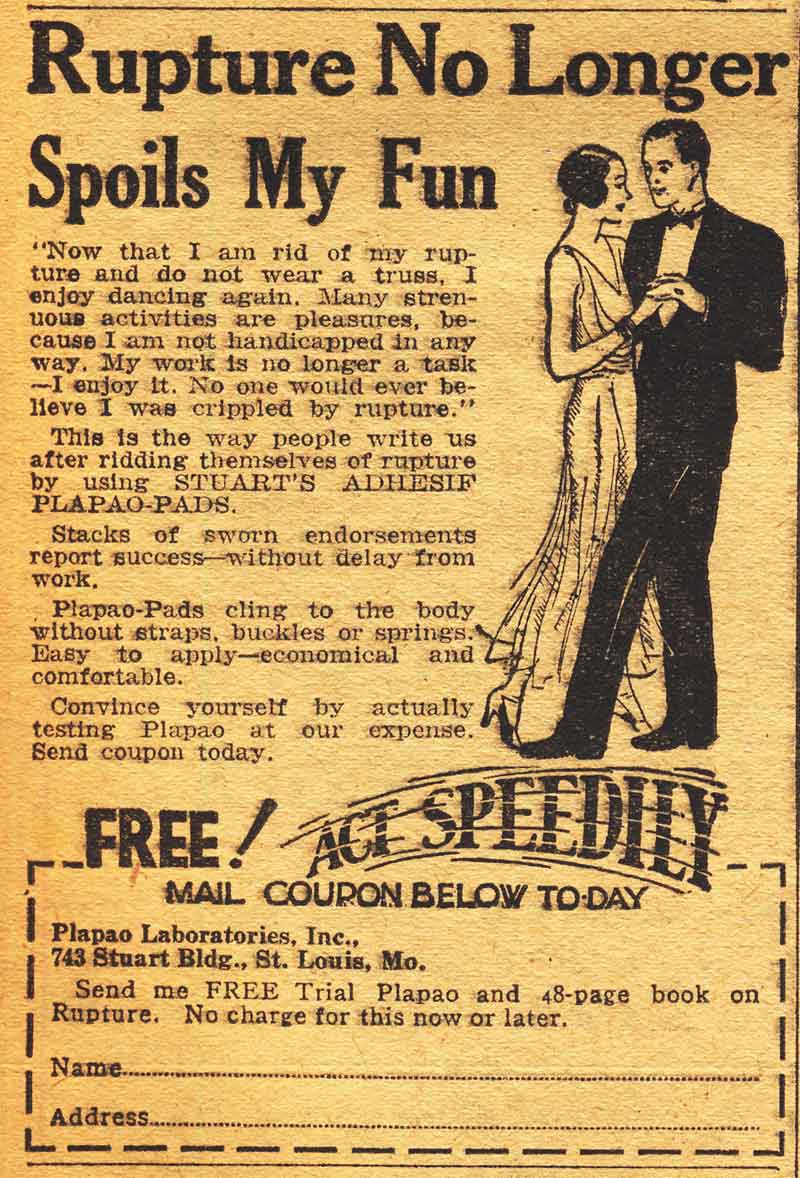
Rupture No Longer Spoils My Fun


Pin It

Friday, December 21, 2012

1910 Chiclets Ad

The refinement of chewing gum for people of refinement.
Pin It

Thursday, December 13, 2012

AT&T's U-verse

A 1910 Argosy Magazine ad for AT&T's U-verse (Universal Service).
Pin It

Sunday, October 14, 2012

Rothschild & Company: No Puzzle Schemes

Pin It

Wednesday, October 10, 2012

The Ostermoor Smile

Pin It